

Real change doesn’t happen overnight. It is usually the result of countless hours of practice, learning, and accumulation of knowledge, as well as many attempts that end in failure that never see the light of day. My work has followed this pattern.
I have conducted many personal experiments on my own body. Many presumed harmless experiments brought me right back to where I started – to the same lower back symptoms I had been experiencing. Some experiments were disappointments. Some experiments generated true potential breakthroughs, thus increasing my understanding of the nervous system itself. I have been hesitant to write about my work in the last two years, for the sole reason that my understanding has constantly been evolving. Sometimes even week to week. While the clinical practice has stayed largely stable in regard to what I introduced over time, my behind-the-scenes breakthroughs were numerous and potentially profound. When I tested these new breakthroughs thoroughly on my own body for months on end, I would roll them out to certain clients that I thought could benefit from them. The results have been quite dramatic. Each observation has been built from the previous, adding to the next. As of today, this has developed into a functioning clinical framework that I use with an incredibly wide range of clients and presentations, including:
-Pain
-Instability
-Tension
-Chronic injury
-Nervous system state
-Associative emotional triggers
-Phobias
-Improvement with various issues connected to EDS/POTS/MCAS
-Athletic performance
Did I plan on working with any of these issues? The answer, frankly, is no. It started with trying to solve my own physical issues, and over the years, with requests to venture into adjacent territories based on referrals and recommendations, the list expanded. Is the clinical model done? By no means. It is constantly being updated as I learn more about specific aspects of the nervous system, continue to experiment with my own body, and attempt to thoroughly research the phenomenon I see daily. But once again, change does not occur all at once. The last year has likely held more progress and understanding than the previous 7 combined. This article is to specifically document recent breakthroughs, so that you may better understand the catalyst behind the evolution.
First, I must specify. Throughout this article, when I use the word “signal,” I am referring to the individual’s subjective perceptual report of where a task is first felt as force is introduced. I am not using perceptual signal as synonymous with muscle activation. A muscle may visibly contract without being the primary location of reported sensation.
Questions
One of the things that bothered me the most over the last 8+ years of clinical work was the inability to consistently see the same result. Some individuals would respond beautifully to a load-based or tapping/rubbing-based sensory intervention for specific areas of the body. It worked so well that it was occasionally deemed “wizardry” by certain clients due to the speed of beneficial change being much more rapid than one would ever expect. In many cases, I would see this type of result, and if not at that speed, then over a short amount of time with significant improvement in clinic and outside of clinic being reported. But there were individuals who did not respond this way at all. They seemed almost incapable of very simple load-based tasks, even at extremely modified (reduced difficulty/load) positions. Take a very simple wall sit. Most individuals would report a significant level of subjective signal/sensation from the specific muscles that one would expect biomechanically in a high version of the wall sit. Sensation would increase with load or as they lowered their body. As this “sensory signal” improved under load, so did their outcomes. Some failed to do so, but a brief sensory intervention of tapping/rubbing of the quadriceps in this case often produced the change in subjective signal that we were looking for. This often came with a substantial reduction in low back, hip, or knee pain. This was great to see and made me believe that I was onto something significant. You can see evidence of that in previous articles I have written.
But some did not report any kind of signal/sensation in the quadriceps (or other biomechanically expected regions for the exercise), no matter how much they rubbed or tapped the muscle before or after the intervention. Even when using EMS or vibration technology, they said that sensation remained elusive. Pain could change with these types of stimuli, but it seemed almost as if the system could not express load through that given biomechanical area when tested. That was my hypothesis back then, with no real way to defend it.
I knew sensation in a given muscle in a given loaded position was potentially a big deal from my previous 7+ years of work as well as previous personal experience. At the time, I believed it was evidence of some level of activation, and while it was an important variable, I could not fully explain it. It did seem directly tied to positive clinical and personal outcomes, so I continued to pursue it. But it was inconsistent. Sometimes it worked beautifully. Often it did. Occasionally it did not. This bothered me. But I had no real answers for these outliers. Even the modified positions I considered extremely low-load did not appear to work for them. Tapping/rubbing only worked briefly for them. They could still generate the movement output, but it seemed as though completing the task required a different and perhaps more costly solution.
For example, I had clients who could easily do the wall sit, and when asked to attempt to lean slightly into one leg, they reported consistent quad sensory feedback. When they leaned to the other (often the side with more symptom history), there would be an absence of sensory feedback from that quadriceps, and sensation could instantly migrate to the knee or the hip. Biomechanically, I had reason to expect substantial quadriceps contribution in the higher position, with increasing contribution from the glutes as the position lowered. I was using sensory feedback as a proxy for improved function of a muscle at the time (though I understood this was controversial). But once again, I did not always observe the expected perceptual result with load, even when it was extremely reduced.
While I could positively influence symptoms, persistence of specific function or pain-free outcomes for certain individuals was inconsistent. And while the quads in a wall sit are a simple example, I would see similar issues in other regions of the body. Biceps. Pecs. Rhomboids/mid traps. Abdominals. Obliques. Calves. Glutes. Etc. I saw these “full disconnect” types of issues more often with EDS/POTS/MCAS as well as intense past trauma presentations. I assumed some kind of capacity limitation was a possible issue, or perhaps some deeper neurological disconnection phenomenon. But then, I had an experience that would fundamentally change how I viewed the body and the nervous system forever. It happened on a mountain.
The Hike
My wife loves to hike. Scratch that, she loves to move. She runs. She wants to climb Mt. Hood. She trains daily.
About a year ago, I decided that in order to support her goals and be a good husband, I would embrace hiking, despite my physical inconsistencies at the time. I was pain-free in my day-to-day life due to the many breakthroughs I had experienced over the years. The car accident and the severe chronic pain that had come with it were only a distant memory. However, under higher physical demand, certain symptoms could still appear. My hip flexors, my knees, or even at times my lower back would suddenly flare. Most of these issues were clustered on my left side, the side that I felt was weaker and less developed. This was also the side that had been injured in the car accident. My left leg seemed extremely unwilling to respond to traditional rehab or strength work. When I tried to load that particular side, weird symptoms could appear through the low back, the hamstring, or the hip flexors. The slight tension, pain, or tightness was transient because I could use my work to eliminate these symptoms. But the moment I would try to strengthen that side again; symptoms could once again reappear. The seemingly random nature and unmappable inconsistency of these symptoms confused me. One day I could do a movement or an exercise with zero issues. One day I could do the same task/movement and have brief symptoms. I had no real answers, other than that I either lacked some unknown muscular capacity and needed to just continue to slowly improve strength over time, or had some deeper nervous-system-based “disconnection” issues.
We started our hiking journey with a 2-mile flat walk that just about finished both of us, such was our poor conditioning. The very first time we went out, I realized just how much I had personally and physically needed to move again. I also realized just how much of a caring wife I had. She truly pushed me to challenge my body again. Fear of chronic pain is a real thing, and looking back, it is hard to say that I was not fearful of hurting myself again.
By the end of the season, we were tackling 6-8 mile hikes. My body felt greatly improved in regard to my ability to handle longer outings and increased load. I continued my work as we hiked, and I did notice myself becoming stronger. Output was increasing. Still, there were issues. My calves would scream at me when climbing hills, my hamstrings were still tight, and my back would complain here and there from jumping or landing awkwardly. My assumption was that this highlighted a potential tissue or capacity problem.
The last hike we did that season was Table Mountain. Now, you may not live in the area, but let me tell you, Table Mountain is no joke. It is 7+ miles, and much more difficult than anything we had tried that season. This was a serious mountain for serious people. Looking back, I don’t think I qualified as “serious people” at the time, though my wife certainly did. We started much too late in the day, something that would haunt us as we started this climb.
Some moments are only funny and humorous when looking back at them. This was one such time. What started as a very difficult climb (needing to hang onto branches and pull myself up due to the steepness) turned into an overwhelming challenge as we scrambled up the rockslide portion and navigated ledges along a sheer cliff, thousands of feet above ground. We even had to scoot on our butts to make sure we didn’t trip near the edge. Did I mention I don’t love heights? Needless to say, this was difficult beyond what I had ever expected. Still, we were doing extremely well. Things changed around two specific challenges.
- It was getting dark right as we got to the top of the mountain. We could see the sun starting to set. We were many hours of descent from the car on a treacherous mountain we had no experience with. We had left far too late in the day.
- One loose rock at the very top of the mountain, and I severely strained my right calf. It felt like it might spasm and go into a severe strain as I summoned up deep calm, firmly grabbed the calf, and breathed deeply until I could work my foot slowly from dorsiflexion to plantarflexion and back again. To my relief, it released. Though it still hurt to the point that I needed to limp, I was able to continue.
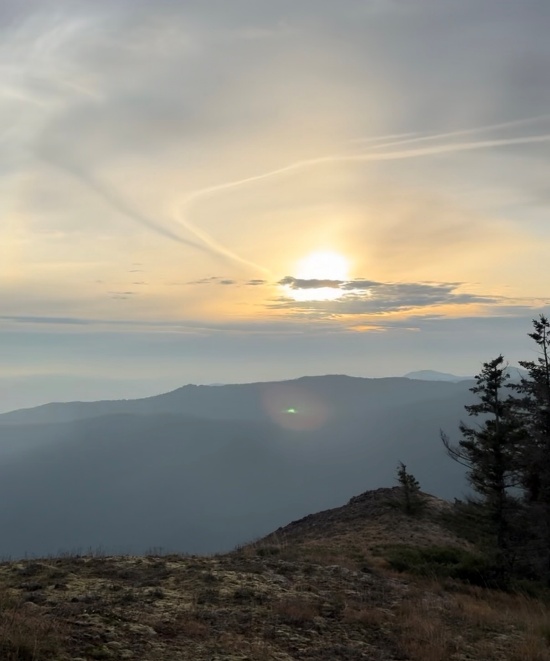
We were at the top of the mountain, and the sun was starting to set. The sky was a pinkish hue. I was deeply concerned. I had just strained my “strong leg” at a time when I needed it the most. I now had to trust my left leg, my historically weak leg, the one that had been “injured” in the accident. I needed to trust this leg all the way down the mountain. This was a problem, and I could feel anxiety rise. I knew deeply from experience that I did not have the strength in this leg to handle this extremely intense descent (holding onto tree limbs or whatever I could grab). The descent was beyond difficult. It forced us to move sometimes no faster than a crawl.
It was stressful. It was painfully slow. I navigated the calf strain, putting gentle and deliberate weight on the weaker leg, trying to lighten the burden as much as I could with branches and low-hanging trees. There were loose rocks all over the path. Standing was out of the question at times due to the dangerous grade of the descent. We were only halfway down as the sun set.
Fast forward 3-4 hours. It was pitch black and my wife had a headlamp on. We were hungry. I was using my cell phone flashlight to illuminate our path. We were almost there. The descent was minor at this point. We had had a few harrowing moments between us on the way down, but we made it.
Suddenly, I realized something profound. I was putting 100% of my weight on my left side, the “weak” side. To my amazement, I was jumping and landing solely on my left leg. I was quickly ducking spider webs and branches and feeling zero low back tension, whereas doing that a few hours ago created pain from time to time. My left leg had become my strong leg. I could not explain it. My knees were fine. So were my hamstring and my low back. The left leg felt…solid. It did not feel like the leg that went up the mountain. I was stunned.

A Phenomenon
I woke up the next morning expecting to be sore. What I did not expect was barely being able to move. I was deeply fatigued. It was even difficult to walk. Still, the left leg held on to the sensation of stability from the day before – only slightly less.
By the next day, the feeling of stability and strength from the left leg had returned to a more familiar and chronic condition. Slightly unstable. Hard to sense when loaded. Weaker than my right. I was at a loss and I had no explanation. This should not be possible. I thought perhaps it was a stress-induced change only, or perhaps some mind-body phenomenon connected to autonomic state. My perception was that of diminished strength, shown by the returning tension in my knees and hamstrings. This made me deeply suspicious. So, like I had done in the past, I began to experiment with my body.
I tested specific muscle loads at various degrees. I tested sensory inputs for the nervous system. I tested breath as an autonomic state lever. I tested standing as opposed to sitting. I tried to recreate the phenomenon that I had found on the mountain. I tested my body for months. In this process, I even accidentally recreated many of my old symptoms with my low back and hip. So much so that one day I tried to get out of bed and could not sit up, try as I might. It was terrifying. But I felt it was also a clue. Perhaps I was closer to the solution than I had thought. How could I provoke such intense symptoms with nothing more than brief sensory inputs and minimal load compared to what I had been enduring all hiking season? This was a question that I could not answer, at least not yet. I worked through these symptoms using my understanding of the body I had built from the previous 15+ years of research and work, stabilized, and continued to test.
At this point, the work began to shift from a more traditional understanding of the body to increasingly complex constructs that required intense focus and research. I found myself lying awake nightly, obsessed with what the mountain had shown me. I realized that it was possible that I didn’t know my own body. I knew there were other pieces to the mystery of my body that I could not currently grasp. I had spent 15+ years on this journey to restore my physical health. I would not quit.
I hope that you have enjoyed The Mountain Part 1. Part 2 dives into some of the more complex concepts and understandings that have become the bedrock of my current operational framework. It begins with the most significant breakthrough in terms of my work, and equally the most significant breakthrough that my physical body has experienced. See you in part 2!
-A
Grateful for you my friend! What a blessing and honor to work collaboratively with you over the last few years. Thank you for the long hours of work you put into testing and developing your body of work. Thank you for the vulnerability and courage you are expressing sharing your Mountain experience with us here in Part 1. I love how you continue to challenge yourself to improve on your previous work which has already helped me personally and so many of my clients! Looking forward to reading Part 2!!!! Heck ya let’s gooooo!
Wow. Can’t wait for Part 2!
thanx 4 sharing ur work here. its depth and complexity reminds me of essays I read on Substack. u shud consider writing there???
Very interesting reading! I feel I was fortunate when working with you that the things you had me do for my shoulder – the rubbing/tapping/flexing and working on specific muscle groups worked. Then the wall sits when my lower back was bothering me – I still do those and I haven’t had any real issues since then. Every once in a while – usually when I’m really stressed – my lower back will let me know and I add more wall sits in. Our bodies are so complex and the more we learn the more there is to learn. I’ve been pleasantly surprised lately that, since I started working with a functional medicine doctor to decrease the inflammation in my body, the stubborn, tight spot on the left side of my neck that has plagued me for years is now almost gone. For years I used heat, ice, pain rubs, dry needling, massage, new pillows – nothing provided more than a temporary relief to that area. Haven’t used anything in two months and while there is still a minimal amount of tightness in that area, it’s so much better. I’m looking forward to Part 2 of your essay!